
Global Warming already in the Pipeline (updated February 4, May 13, August 6, November 6, 2025)
James Hansen et al.
I already published the text below earlier this month, in a post with “(p)” in the title, meaning subscribers did not receive an email notification for it — one of a periodic compilation of things I’ve read that I find noteworthy. But encouraged by Thomas Homer-Dixon’s piece in the weekend Globe and Mail, who calls the article by Hansen et al. “the most important scientific article I’ve read in a decade,” I now publish my take on it as a separate post.
The illustration is another transfer from that same “(p)” post:
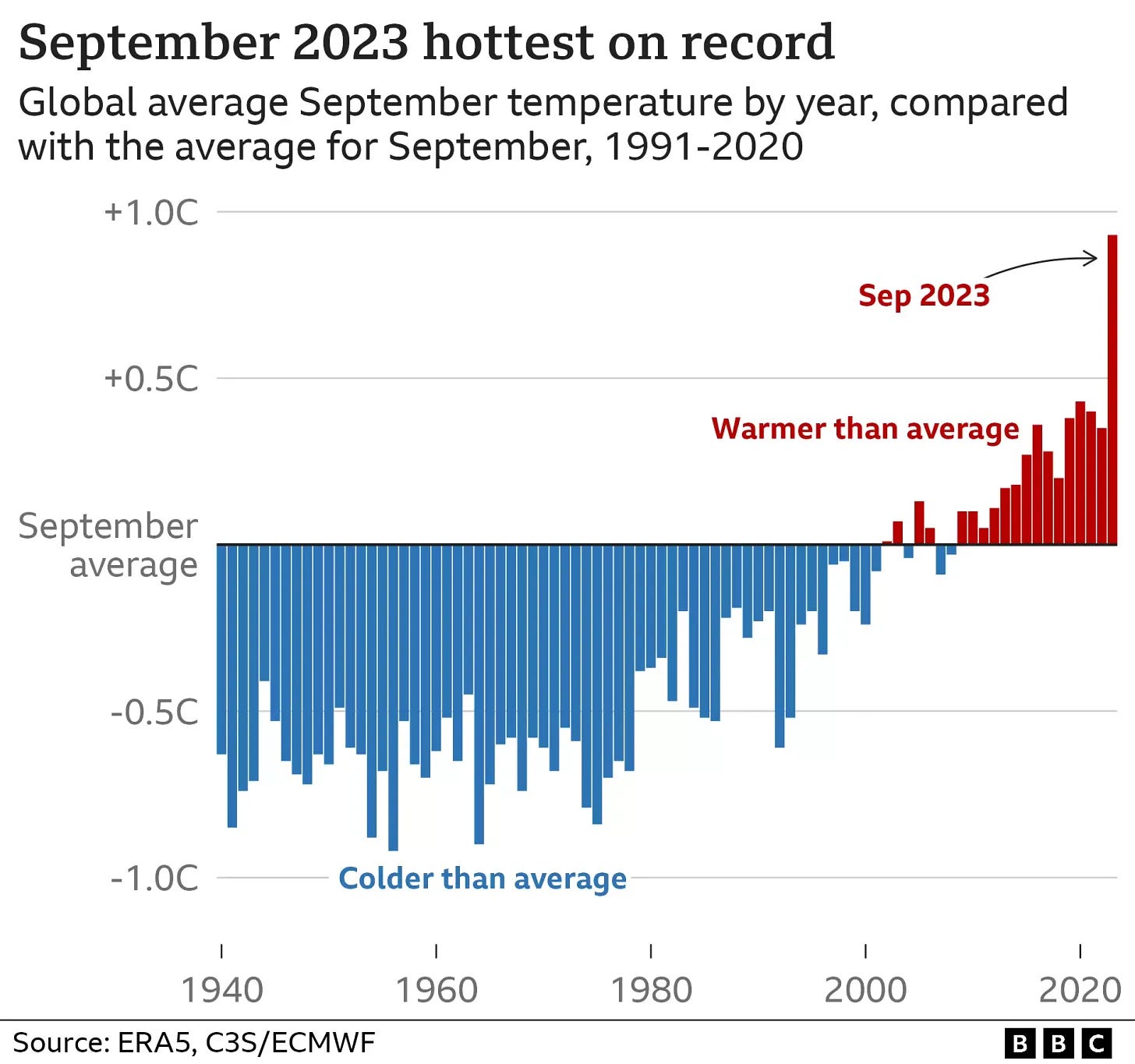
From https://www.bbc.com/news/science-environment-67017021. “Warmest September on record as 'gobsmacking' data shocks scientists.”
Be aware that this September peak, followed by an equally record-smashing October, is fuelled by El Nino and, while consistent with Hansen et al.’s claim of accelleration, may well attenuate over the longer term.
=====================================================================
James Hansen and 17 co-authors challenge the approach taken by the IPCC in a new paper published in Oxford Open Climate Change, entitled “Global Warming in the Pipeline“ (2 November 2023). Hansen previews it in his 27 October 2023 newsletter, “To Understand and Protect the Home Planet,” available here: http://www.columbia.edu/~jeh1/. He argues that the IPCC analysis relies too heavily on Integrated Climate Models; they are important but need to be complemented by information from paleoclimate history and observations of ongoing climate processes.
He returns again to the issue of aerosols (which he has raised since the 1980s) and why their non-measurement results in a free parameter in climate models. Paleoclimate analysis suggests that climate sensitivity to aerosols is higher than the IPCC models assume, which means that the “Faustian payments” which come due as we clean up air pollution are greater.
One paragraph in his newsletter complains about the little attention paid to nuclear energy; he insists that without it, fossil fuels will remain necessary forever. (Even great minds have blind spots.)
Finally, he decries scientific reticence — not willing to say things as they are. In a 2016 paper, “Ice Melt, Sea Level Rise, and Superstorms,” he was forced to change “2°C global warming is highly dangerous” to “…could be dangerous” in the subtitle. As another example, scientists are underplaying the likelihood of the North Atlantic and Southern Ocean Overturning Circulations shutting down.
An 1h12m video, An Intimate Conversation with Leading Climate Scientists To Discuss New Research on Global Warming offers a discussion of the Pipeline paper: Hansen in the first 20 minutes, followed by some of his co-authors, including George Tselioudis (from 22:07 to 28:46) who compares various IPCC models with actual observations about cloud sensitivity, Leon Simons (34:22 - 42:11) who goes deeper into the new data obtained from the change in maritime shipping emissions rules and the Earth’s Energy Imbalance (EEI), and Norman Loeb (42:25 - 48:23) who talks about the satellite observations of EEI. Q&A with international media reporters starts after that.
A further follow-up is in his November 10 communication, available here. Its title says it all: “How We Know that Global Warming is Accelerating and that the Goal of the Paris Agreement is Dead.“ (This refers to the 1.5dC goal.)
See also this November 3 Newsweek article, discussing the Pipeline paper’s advocacy of solar engineering. Not a word about the IPCC models’ cloud sensitivity parameters, which are the core of the paper’s argument; the new evidence from oceanic traffic is mischaracterized by an IPCC modeller.
Update - February 4, 2025
Hansen et al. have a new paper that appears to cover the same ground as the one in Oxford Open Climate Change, now in Environment: Science and Policy for Sustainable Development , Volume 67, 2025 - Issue 1:
https://www.tandfonline.com/doi/full/10.1080/00139157.2025.2434494#abstract
It has Supplementary Material (SM):
https://www.tandfonline.com/doi/full/10.1080/00139157.2025.2434494#supplemental-material-section
From line 504 to line 599 SM responds to reactions to the papers.
The Guardian covered the issue on February 4 as well.
Update - May 13, 2025
(See also my April 3 Diary entry.)
James Hansen’s May 13 communication continues his critique of IPCC’s estimate of climate sensitivity. Here his focus is on the impact of changes in the Earth’s albedo (reflectivity).
https://www.columbia.edu/~jeh1/mailings/2025/CloudFeedback.13May2025.pdf
Since early 2000 (when precise satellite data became available), Earth’s albedo has decreased about 0.5%. In the Intimate Conversation webinar following the Pipeline paper he called this a BFD.
Key point (the text gets quite technical):
The only substantial climate forcing affecting Earth’s albedo is the “indirect” aerosol forcing that occurs via the effect of aerosols on cloud formation and cloud brightness. IPCC estimates this indirect aerosol forcing change in the past 25 years as only about +0.1 W/m2, while we – based on the geographical and temporal change of absorbed solar radiation – estimate a larger aerosol forcing, +0.5 W/m2, due to reduced aerosol emissions from ships and thus reduced cloud cover.
Mainly, though, he complains about the media who rely on a “clique” of climate scientists, neglecting the many other competent scientists who could provide perspective. (Well, he can’t complain about how Thomas Homer-Dixon treated his findings.) He vows to spend the next three communications explaining in plain language the three bases of his argument: (1) observations of ongoing climate change, (2) global climate models (GCMs), and (3) Earth’s long-term climate history (paleoclimate data). They lead to his conclusion that the right number of climate sensitivity (air temperature increase from doubled CO2) is 4.5°C ± 0.5°C W/m2, not 3°C ± 0.5 °C W/m2 as the IPCC maintains. In his analysis, “Climate sensitivity as low as 3°C for doubled CO2 is excluded with greater than 99 percent confidence.“
Update - August 6, 2025
Jim Hansen has joined Substack. This post summarizes his papers, Global Warming in the Pipeline and Global Warming has accelerated.
Update - November 6, 2025
For his talk in Helsinki, go here.